
 Image 1 of 1
Strokes in Color (Online Course) Spring 2027 w/ Carol Tarzier
May 21 to June 11 (Fridays), 3:00 PM to 6:00 PM, Eastern Time
**All sessions are live and will be recorded, students do not have to be present. All recordings will be available to students for 3 months after the final session, after 3 months the recording will be deleted.
Please check your email spam/junk folder for your Zoom invite. Our business hours are 10:00 AM through 5:00 PM. All course information and email correspondence will be sent during business hours. If students purchase a course, workshop, demo or recording outside business hours or during the weekend the course information or recording will be sent the following business day.
Course Description
This course is an introduction to brushstrokes and color using landscape and still life.
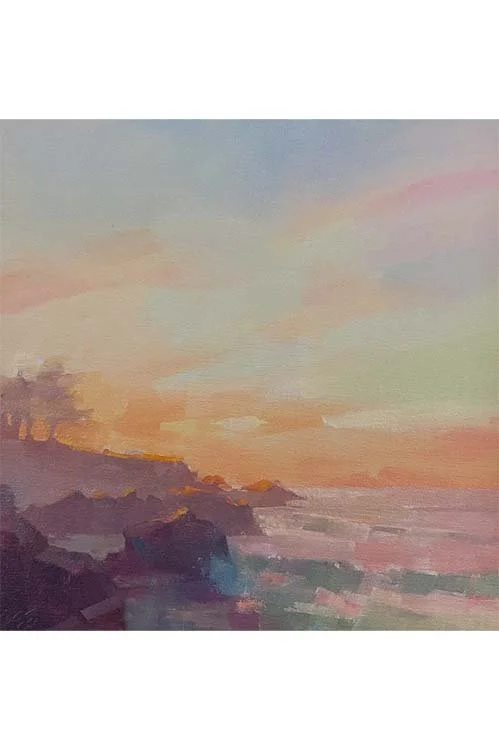
The course begins with landscape. We begin with a 25 stroke painting exercise that combines all the elements – brushstrokes, color mixing, composition. Photo references (provided) include clouds at sunset and shoreline water. The Still Life instruction moves into designing the composition using a viewfinder and understanding the canvas edges as the pathways into the painting. The class will cover saturated versus tinted color to create light on the canvas, then into lost edges for metal and reflections and luminosity through soft edges and saturation.
Each class features a completed piece and a demo of the process. I enjoy working with students of all levels - the course is open to all levels and I will discuss student work on an individual basis. I welcome comments and questions during the online sessions.
Course Outline
Week 1
Palette/Color mixing using limited palette
25 Stroke Painting Exercise from a landscape photo “Clouds at Sunset”
25 Stroke demo
Week 2
Seascape with clouds
Brushstrokes for waves
Sunset color transitions
Landscape with clouds demo
Week 3
Composition and shadow warm to cool transition/ Luminosity as light travels through the object
Cantaloupe slices demo
Week 4
Painting silver and reflections/ Tangerines or citrus and slices
Getting the glow, Lost Edges
Citrus with Silver demo
Course Materials List
Supplies are suggested. If you cannot get supplies for the first class, bring in the closest match.
Turpenoid Natural or brush cleaner in Silicoil brush washing container.
Gamsol odorless thinner in small container for medium
Medium – M. Graham walnut alkyd medium or M. Graham Walnut Oil
Oil paint colors. Here is a suggested palette. M. Graham paint is made with walnut oil. M. Graham is available online (Blick or Amazon.)
Cool red/Violet – Quinacridone Rose or Cad Red Deep
Violet – Quinacridone Violet
Warm red - Cadmium Red Light or Cad Red Medium or Azo Coral or Scarlet Pyrrol
Cool yellow - Cadmium yellow light
Warm or medium yellow - Cadmium Yellow Medium
Transparent yellow – Indian Yellow or Quinacridone Nickel
Violet or red leaning blue - Ultramarine blue
Warm or medium blue - Thalo Blue Red Shade
Titanium white
Canvases or canvas-coated panels. Internet suppliers - Source-Tek or Raymar or Centurion panels, any size from 6”x 6” to 8” x 10” or canvases from Michaels or Blick. I use Fredrix Pro Dixie primed cotton canvas.
Brushes – I order from Rosemary & Co, UK.
Rosemary & Co has a large assortment, this is a suggested list.
Ivory series Long Flats #4, 8, 14, Or Evergreen series long flats #4, 8, 12,
angles 3/8”, ½”
Ivory series 2” impasto brush
Sable angle brushes or sable long flats
Bristle brushes - long filberts or Egberts
If you are buying local - two long flats one smaller one at least 1” wide, and a couple of filberts. Watercolor brushes work for oil painting.
Paper or glass or plastic palette.
Studio easel or plein air easel if you prefer your own.
Color wheel
Graphite or charcoal pencil
Paper towels, soft (Viva or blue auto paper towels from Costco)
Isopropyl alcohol for cleaning the palette and brush handles
Viewfinder –The Color Wheel Company 7002 View Catcher from Amazon.
Materials for setup – White cloth, black cloth, a gooseneck or similar light, backdrop
Reading Reference– “Daily Painting”, Carol Marine