
 Image 1 of 1
Oil Pastel: Lessons from Bonnard & Diebenkorn (Online Course) Spring 2027 w/ Samir Rakhmanov
April 2 to April 23 (Fridays), 11:30 AM to 2:30 PM, Eastern Time
**All sessions are live and will be recorded, students do not have to be present. All recordings will be available to students for 3 months after the final session, after 3 months the recording will be deleted.
Please check your email spam/junk folder for your Zoom invite. Our business hours are 10:00 AM through 5:00 PM. All course information and email correspondence will be sent during business hours. If students purchase a course, workshop, demo or recording outside business hours or during the weekend the course information or recording will be sent the following business day.
Course Description
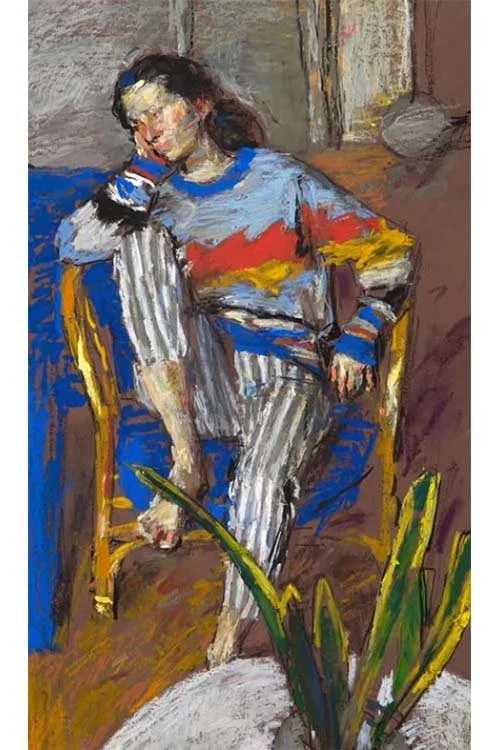
This course explores oil pastel through the work of Pierre Bonnard and Richard Diebenkorn. Throughout the program, students will examine how these artists transformed observed reality through decorative composition, flattened space, complex color relationships, expressive mark-making, and the integration of the figure into its surroundings.
Each class will begin with a presentation analyzing selected works by Bonnard and Diebenkorn and exploring how their approaches can inform students’ own practice. This will be followed by an oil pastel demonstration translating these ideas into practical techniques.
The aim is not to imitate either artist’s style, but to understand their visual strategies and adapt them to a personal pictorial language.
Course Outline
Week 1: Decorative Composition Through Still Life -
The first class explores how Bonnard and Diebenkorn transformed observed subjects into strong geometric compositions. Using still life, students will practice flattening space, simplifying objects, and organizing the image through large interconnected shapes.
The demonstration will show how to develop this structure in oil pastel using a limited color palette, with particular attention to the tabletop, the placement of objects, and the spaces between them.
Week 2: Flat Color Through Still Life -
The second class focuses on creating a rich still life through flat color. Students will explore how color relationships, temperature shifts, layering, and repetition can enrich the image without relying on conventional modeling.
The demonstration will show how to build color complexity within individual areas while preserving the clarity and unity of the larger shapes.
Students will arrange their own still life for each of the first two assignments, creating a new setup for the second.
Week 3: Mark-Making and Movement: Gouache and Oil Pastel -
The third class examines how brushwork, drawn lines, and visible revisions create rhythm and movement in the work of Bonnard and Diebenkorn.
The demonstration will show how to translate these painterly qualities into a combination of gouache and oil pastel, exploring the interaction between painted areas and drawn marks.
Week 4: The Figure Within Space -
The final class focuses on integrating the figure into its surroundings. Students will use color, shape, cropping, and spatial relationships to create a unified figurative composition in which the person and environment function as a single pictorial structure.
The demonstration will show how to integrate a figure into an interior through shared colors, connected shapes, and the selective definition and softening of edges.
Each class will include a presentation on the topic, followed by a prerecorded demonstration with live narration and a Q&A session. Students should submit their homework on Wednesdays. I will review the work on Padlet each Thursday, providing written feedback and digital paintovers. During Friday classes, I will answer any additional questions.
Course Materials List
Oil Pastels
Recommended brands: Sennelier, Van Gogh (Talens), Holbein, Mungyo Gallery, Kuelox
Optional: Fixative for oil pastels or general acrylic fixative (varnish)
Example of a basic oil pastel color set based on the Sennelier color chart
Possible Surfaces
Paper, cardboard, fine-weave canvas, wooden board, MDF, or plywood
Materials for Underdrawing
Charcoal, graphite, eraser
Palette Knife
Gouache and Brushes
For the third assignment, which combines gouache and oil pastel
Other water-based paints, such as watercolor, acrylic, or tempera, may also be used
Other Materials
Tissues or paper towels for cleaning hands and materials
Thinners such as turpentine, white spirit, or Gamsol (optional)
Objects for still-life setups
Draperies for colored and patterned backgrounds: red, green, blue, yellow, etc.
Water container and palette for gouache
A person to pose for you or someone you can photograph for reference