
 Image 1 of 1
Evolution of a Painting (Online Workshop Webinar) Spring 2027 w/ Amy Brnger
April 13 to April 27 (Tuesdays), 2:00 PM to 5:00 PM, Eastern Time
**All sessions are live and will be recorded. All recordings will be available to students for 6 months after the final session, after 6 months the recording will be deleted.
Please check your email spam/junk folder for your Zoom invite. Our business hours are 10:00 AM through 5:00 PM. All course information and email correspondence will be sent during business hours. If students purchase a course, workshop, demo or recording outside business hours or during the weekend the course information or recording will be sent the following business day.
**Note: there is no Padlet component to this webinar for participant feedback. The webinar is held via Zoom Webinar format.
Workshop Webinar Description
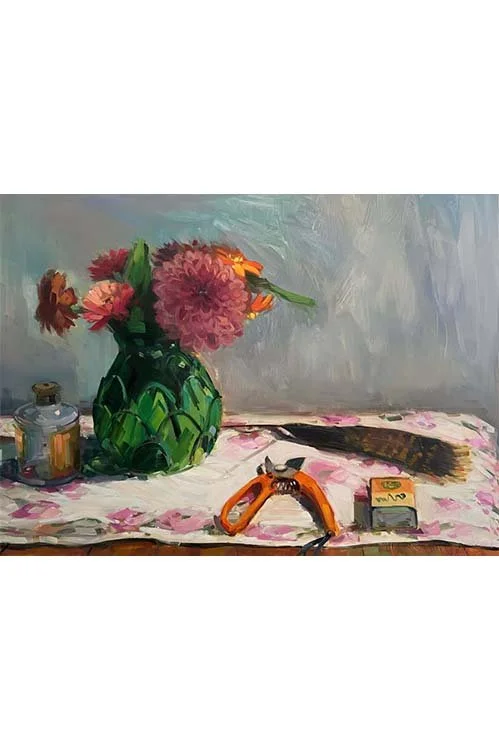
Paintings rarely stay the same as they evolve from an idea, creating a composition, laying in of shapes, developing a color scheme, and finding its way to a finished product. This webinar will focus on the development of a more substantial painting as Amy develops a single painting over three sessions.
Participants will work on a still life painting of their own, using Amy’s demonstrations as a jumping off point. Scraping down and repainting will be encouraged, as well as moving around objects, adding or subtracting items, and building a surface that feels inventive and unique.
Participants can use the medium of their choice. Amy will be creating a painting using oil paint and will be talking about this medium extensively, but many of the discussions and principles will be the same across wet mediums.
Workshop Webinar Outline
Week 1
Setting the stage. Objects are selected, view point, light source. Sketching out versions on paper and the painting surface. Time permitting, an initial paint sketch focusing on values and object relationships.
Week 2
Heavy painting lay in. Reassess relationships, work in major colors and shapes. Scrape out and paint in. Find places for visual activity and rest.
Week 3
Refine the painting. Continue to work on surface development, refine the object placement and relationships, address lines and disappearing edges. Discussion, while working, about when a painting is complete.
Workshop Webinar Materials
Use a larger substrate for this webinar. Amy will likely work with a 24 x 24 or larger panel. Ampersand Museum Panels and Raymar Panels are both nice, but look for a surface that has some tooth to it so that your paint has something to hang onto.. Gessoed paper is fine, taped to a board. Just know that if you like your finished painting and want to frame it, gessoed paper will be a pricey venture.
Brushes of your choice. Please have some 1” brushes on hand. I will be using mostly brights, both hog bristle and synthetic and will have just a few small brushes for beginning and ending the painting process.
Paints: use what you have on hand. I usually teach with a double primary palette, but there is lots of flexibility with this webinar. Some colors that I always have: titanium white, chromatic black, burnt umber or Van Dyke brown, cad red medium, quinacridone magenta or red, cadmium yellow light, india yellow, ultramarine blue, phthalo blue or teal.
Tools: have on hand a variety of tools to manipulate the surface. Razor blades, palette knives, old credit cards, discarded silverware, sandpaper, rags, paint shapers (see shapers made by Princeton Brush Company sold by Blick).
Medium (oil): refined linseed oil and odorless thinner
Paper towels
I use painting gloves because I am always exposing myself to paint materials. I like the fitted medical/industrial gloves.
April 13 to April 27 (Tuesdays), 2:00 PM to 5:00 PM, Eastern Time
**All sessions are live and will be recorded. All recordings will be available to students for 6 months after the final session, after 6 months the recording will be deleted.
Please check your email spam/junk folder for your Zoom invite. Our business hours are 10:00 AM through 5:00 PM. All course information and email correspondence will be sent during business hours. If students purchase a course, workshop, demo or recording outside business hours or during the weekend the course information or recording will be sent the following business day.
**Note: there is no Padlet component to this webinar for participant feedback. The webinar is held via Zoom Webinar format.
Workshop Webinar Description
Paintings rarely stay the same as they evolve from an idea, creating a composition, laying in of shapes, developing a color scheme, and finding its way to a finished product. This webinar will focus on the development of a more substantial painting as Amy develops a single painting over three sessions.
Participants will work on a still life painting of their own, using Amy’s demonstrations as a jumping off point. Scraping down and repainting will be encouraged, as well as moving around objects, adding or subtracting items, and building a surface that feels inventive and unique.
Participants can use the medium of their choice. Amy will be creating a painting using oil paint and will be talking about this medium extensively, but many of the discussions and principles will be the same across wet mediums.
Workshop Webinar Outline
Week 1
Setting the stage. Objects are selected, view point, light source. Sketching out versions on paper and the painting surface. Time permitting, an initial paint sketch focusing on values and object relationships.
Week 2
Heavy painting lay in. Reassess relationships, work in major colors and shapes. Scrape out and paint in. Find places for visual activity and rest.
Week 3
Refine the painting. Continue to work on surface development, refine the object placement and relationships, address lines and disappearing edges. Discussion, while working, about when a painting is complete.
Workshop Webinar Materials
Use a larger substrate for this webinar. Amy will likely work with a 24 x 24 or larger panel. Ampersand Museum Panels and Raymar Panels are both nice, but look for a surface that has some tooth to it so that your paint has something to hang onto.. Gessoed paper is fine, taped to a board. Just know that if you like your finished painting and want to frame it, gessoed paper will be a pricey venture.
Brushes of your choice. Please have some 1” brushes on hand. I will be using mostly brights, both hog bristle and synthetic and will have just a few small brushes for beginning and ending the painting process.
Paints: use what you have on hand. I usually teach with a double primary palette, but there is lots of flexibility with this webinar. Some colors that I always have: titanium white, chromatic black, burnt umber or Van Dyke brown, cad red medium, quinacridone magenta or red, cadmium yellow light, india yellow, ultramarine blue, phthalo blue or teal.
Tools: have on hand a variety of tools to manipulate the surface. Razor blades, palette knives, old credit cards, discarded silverware, sandpaper, rags, paint shapers (see shapers made by Princeton Brush Company sold by Blick).
Medium (oil): refined linseed oil and odorless thinner
Paper towels
I use painting gloves because I am always exposing myself to paint materials. I like the fitted medical/industrial gloves.