
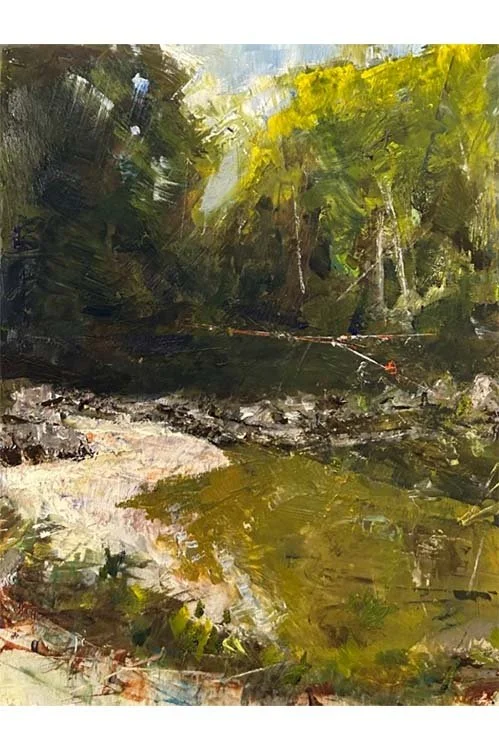
 Image 1 of 2
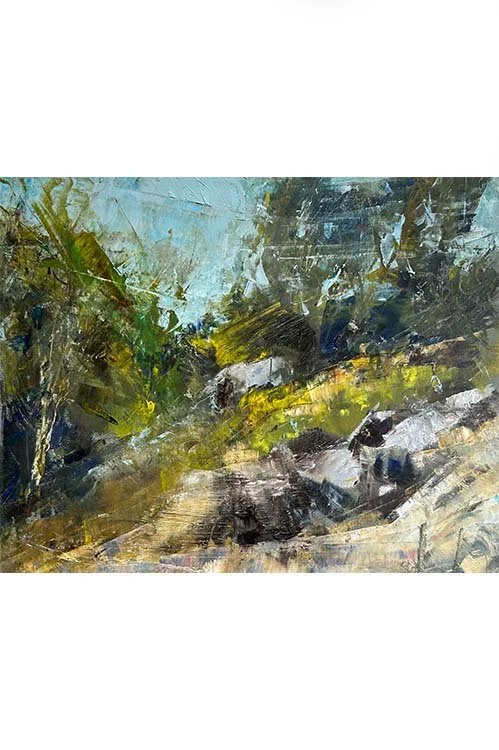 Image 2 of 2
Landscape from Photo Reference (Online Course) Winter 2027 w/ Lauren Davis
March 1 to March 22 (Mondays), 10:00 AM to 12:30 PM, Eastern Time
**All sessions are live and will be recorded, students do not have to be present. All recordings will be available to students for 3 months after the final session, after 3 months the recording will be deleted.
Please check your email spam/junk folder for your Zoom invite. Our business hours are 10:00 AM through 5:00 PM. All course information and email correspondence will be sent during business hours. If students purchase a course, workshop, demo or recording outside business hours or during the weekend the course information or recording will be sent the following business day.
Course Description
Over four sessions we will build a landscape painting from a photo reference, using large palette knives and water-mixable oils. The first session establishes the road map: a grid and a charcoal drawing fixed to the panel, which we return to whenever the painting process gets confusing. From there we move through acrylic underpainting, tonal study, color, and finally corrections, glazes, and finishing touches.
The opening session begins with introductions, a review of the tool list, and a discussion of what I hope to offer and what participants hope to gain. We will make a list of those goals and I will walk through what each of the four sessions will cover.
Course Outline
Week 1 - The Road Map
Introductions, review of the tool list, and a discussion of expectations on both sides. Participants list what they hope to gain over the four sessions.
Painting demonstration on a panel already prepared with a grid and a charcoal drawing of a photo reference, fixed to the panel with fixative. I will show how this drawing serves as a map to refer back to when we get lost in the painting process.
The demonstration panel is also prepared with an acrylic underpainting, so participants can see how that layer functions before trying it themselves.
I will demonstrate a near-finished painting so participants can see the process from start to finish.
Participants practice creating the grid and transferring and fixing the charcoal drawing to their own panels, then receive instructions for practicing this between sessions one and two.
Week 2 - Loosening Up and the Underpainting
We open with a loosening-up exercise: applying very bright acrylic colors to a second panel with big tools — blades and brushes — to get comfortable playing with color. We will paint on this second panel again at the end of session four if time allows.
Remaining questions about the grid, the drawing, and fixing them to the panel will be answered.
We will practice using the Notan app to understand the tonal values of both the transferred image and the original reference.
Participants apply an acrylic underpainting to their panel. This step quickly establishes hard and soft edges, the lightest lights and darkest darks, and the tonal transitions in the composition.
Anyone who did not finish this in session one has a chance to do it here.
Review of the properties of water-mixable oils and which mediums to use at which stage, including the advantages and disadvantages of the water-miscible mediums.
Week 3 - Tone, Color, and Harmony
Review of establishing darks and lights in the acrylic underpainting on top of the charcoal drawing.
This part of the process can feel very messy; I will demonstrate how to go back to the map.
Tonal exercises using Notan sketches to understand tonal relationships.
Review of Cobra water-mixable oils and beginning to lay in color.
Demonstration on unification through a simple, harmonious palette, and how limiting colors ensures harmony.
Discussion of when to use big blades and when to use brushes.
Week 4 - Corrections and Finishing
Apply more paint, make corrections, and return to the map as needed.
Techniques for stitching the composition together so it reads as a whole.
Exploring atmospheric perspective, glazes, and finishing touches.
Participants practice applying paint to establish lights and darks and soft and hard edges.
Course Materials List
Panels
One 8x10 panel
One 6x12 panel
Paint and Mediums
An assortment of water-mixable oils. Cobra by Royal Talens is recommended.
Suggested colors: raw umber, ultramarine blue, cadmium yellow medium, transparent red oxide, titanium white, buff titanium, cadmium red medium, magenta, raw sienna, cerulean blue, viridian green, and ultramarine violet.
Acrylic paint in dark purple, medium red, and ultramarine blue.
If you cannot get Cobra water-mixable oils, you can use standard oil paints together with the Royal Talens gel to make them water-mixable. Royal Talens safflower oil and quick-drying medium are optional.
Tools
An assortment of four or more palette knives and scraping tools, including larger ones - hardware store knives with some flex work well. Bring at least one large tool, 2 to 3 inches.
An assortment of brushes; generally the larger the better. Bring what you are comfortable using, including several flats and one big fan.
Squeegee
T-square and ruler
Black ink pen
Charcoal
Cotton swabs (Q-tips)
Paper towels
Gloves
Water container
Painting tape
Notebook for sketches
Before the First Class
Please install the Notan app, or an equivalent, on your phone — we will use it for a tonal exercise.
Bring a photo reference you would like to work from.
March 1 to March 22 (Mondays), 10:00 AM to 12:30 PM, Eastern Time
**All sessions are live and will be recorded, students do not have to be present. All recordings will be available to students for 3 months after the final session, after 3 months the recording will be deleted.
Please check your email spam/junk folder for your Zoom invite. Our business hours are 10:00 AM through 5:00 PM. All course information and email correspondence will be sent during business hours. If students purchase a course, workshop, demo or recording outside business hours or during the weekend the course information or recording will be sent the following business day.
Course Description
Over four sessions we will build a landscape painting from a photo reference, using large palette knives and water-mixable oils. The first session establishes the road map: a grid and a charcoal drawing fixed to the panel, which we return to whenever the painting process gets confusing. From there we move through acrylic underpainting, tonal study, color, and finally corrections, glazes, and finishing touches.
The opening session begins with introductions, a review of the tool list, and a discussion of what I hope to offer and what participants hope to gain. We will make a list of those goals and I will walk through what each of the four sessions will cover.
Course Outline
Week 1 - The Road Map
Introductions, review of the tool list, and a discussion of expectations on both sides. Participants list what they hope to gain over the four sessions.
Painting demonstration on a panel already prepared with a grid and a charcoal drawing of a photo reference, fixed to the panel with fixative. I will show how this drawing serves as a map to refer back to when we get lost in the painting process.
The demonstration panel is also prepared with an acrylic underpainting, so participants can see how that layer functions before trying it themselves.
I will demonstrate a near-finished painting so participants can see the process from start to finish.
Participants practice creating the grid and transferring and fixing the charcoal drawing to their own panels, then receive instructions for practicing this between sessions one and two.
Week 2 - Loosening Up and the Underpainting
We open with a loosening-up exercise: applying very bright acrylic colors to a second panel with big tools — blades and brushes — to get comfortable playing with color. We will paint on this second panel again at the end of session four if time allows.
Remaining questions about the grid, the drawing, and fixing them to the panel will be answered.
We will practice using the Notan app to understand the tonal values of both the transferred image and the original reference.
Participants apply an acrylic underpainting to their panel. This step quickly establishes hard and soft edges, the lightest lights and darkest darks, and the tonal transitions in the composition.
Anyone who did not finish this in session one has a chance to do it here.
Review of the properties of water-mixable oils and which mediums to use at which stage, including the advantages and disadvantages of the water-miscible mediums.
Week 3 - Tone, Color, and Harmony
Review of establishing darks and lights in the acrylic underpainting on top of the charcoal drawing.
This part of the process can feel very messy; I will demonstrate how to go back to the map.
Tonal exercises using Notan sketches to understand tonal relationships.
Review of Cobra water-mixable oils and beginning to lay in color.
Demonstration on unification through a simple, harmonious palette, and how limiting colors ensures harmony.
Discussion of when to use big blades and when to use brushes.
Week 4 - Corrections and Finishing
Apply more paint, make corrections, and return to the map as needed.
Techniques for stitching the composition together so it reads as a whole.
Exploring atmospheric perspective, glazes, and finishing touches.
Participants practice applying paint to establish lights and darks and soft and hard edges.
Course Materials List
Panels
One 8x10 panel
One 6x12 panel
Paint and Mediums
An assortment of water-mixable oils. Cobra by Royal Talens is recommended.
Suggested colors: raw umber, ultramarine blue, cadmium yellow medium, transparent red oxide, titanium white, buff titanium, cadmium red medium, magenta, raw sienna, cerulean blue, viridian green, and ultramarine violet.
Acrylic paint in dark purple, medium red, and ultramarine blue.
If you cannot get Cobra water-mixable oils, you can use standard oil paints together with the Royal Talens gel to make them water-mixable. Royal Talens safflower oil and quick-drying medium are optional.
Tools
An assortment of four or more palette knives and scraping tools, including larger ones - hardware store knives with some flex work well. Bring at least one large tool, 2 to 3 inches.
An assortment of brushes; generally the larger the better. Bring what you are comfortable using, including several flats and one big fan.
Squeegee
T-square and ruler
Black ink pen
Charcoal
Cotton swabs (Q-tips)
Paper towels
Gloves
Water container
Painting tape
Notebook for sketches
Before the First Class
Please install the Notan app, or an equivalent, on your phone — we will use it for a tonal exercise.
Bring a photo reference you would like to work from.