
 Image 1 of 4
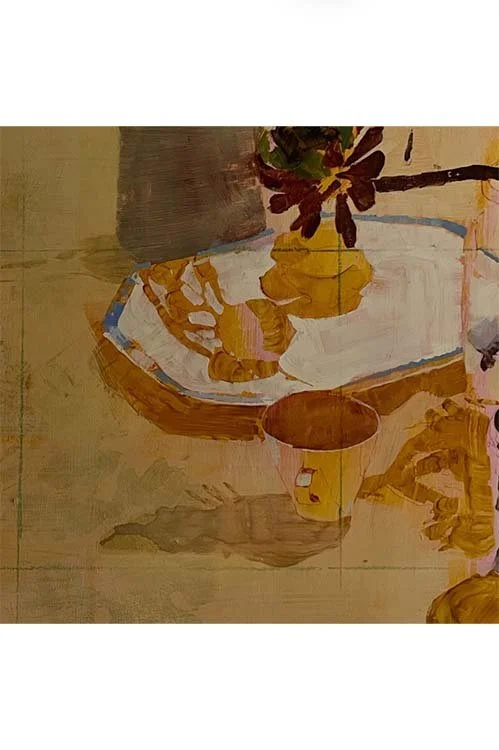 Image 2 of 4
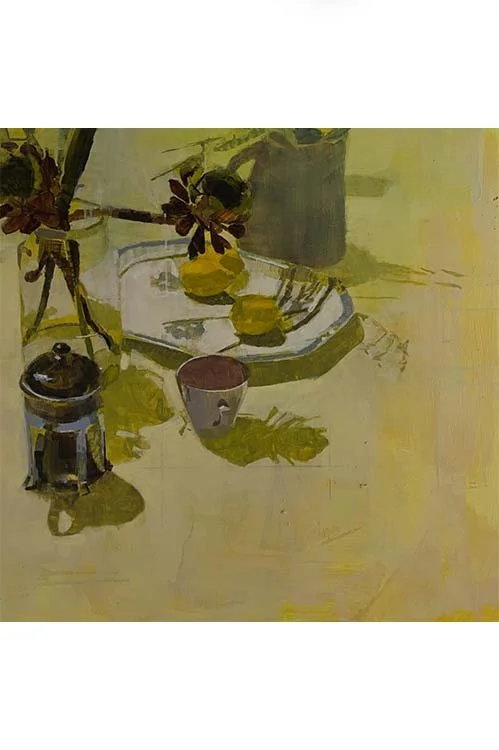 Image 3 of 4
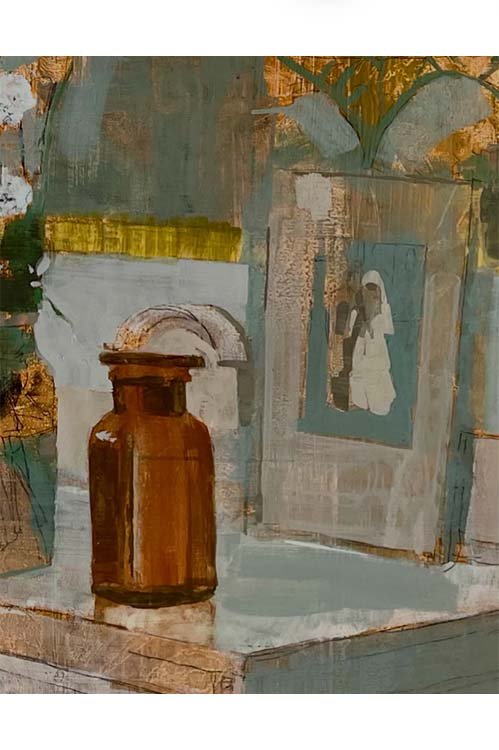 Image 4 of 4
**All sessions are live and will be recorded, students do not have to be present. All recordings will be available to students for 3 months after the final session, after 3 months the recording will be deleted.
Please check your email spam/junk folder for your Zoom invite. Our business hours are 10:00 AM through 5:00 PM. All course information and email correspondence will be sent during business hours. If students purchase a course, workshop, demo or recording outside business hours or during the weekend the course information or recording will be sent the following business day.
DEMO: https://youtu.be/tkDE5P27-hM
‘As music is the poetry of sound, so is painting the poetry of sight.’ Whistler
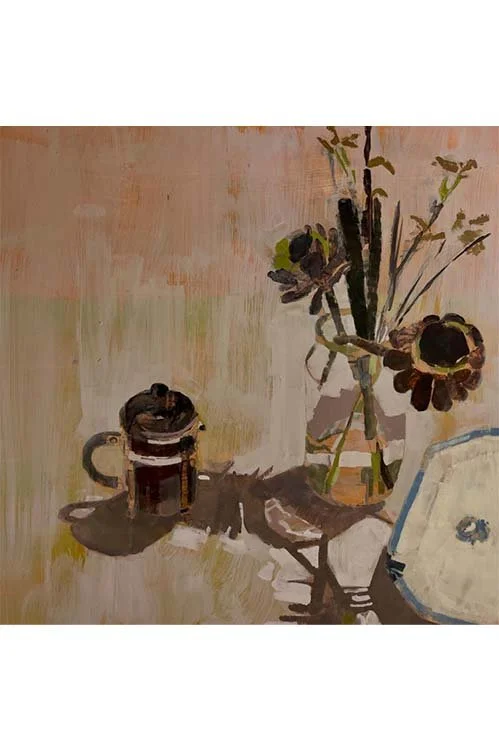
Throughout this four week course I will invite you into my studio to explore how I approach the tabletop landscape. Together, we will work by observing set-ups of ordinary domestic objects – simple jars, bottles, pots and flowers- to create paintings capturing their quietest moment of appearance.
We will look at how my own work builds upon the geometric structures of Richard Diebenkorn and the meditative simplicity of Giorgio Morandi as well as looking at and discussing other artist’s work. Through explanations and demonstrations, I will guide you through my personal process of constructing a composition then layering, scraping, and wiping paint away to find an emotional atmosphere through texture and light. Working towards paintings which balance representation with abstraction.
We will meet weekly on Zoom for live topic overviews, slide presentations, and painting demonstrations. During these sessions, you are encouraged to paint along, ask questions, and discuss both technical and conceptual ideas.
Individual critiques will take place on Padlet each week, supported by our ongoing group discussions. Some basic painting experience is recommended.
Week 1: Composition & The Quiet Horizon
Looking at ways to arrange simple vessels to find structural balance and stillness. We will look at how a simple tabletop line can transform a domestic set-up into a vast, calm landscape. You will use your camera or sketches to find abstract crops before exploring simple two tone compositions.
Week 2: The Muted Palette & Tonal Values
I will share my personal approach to colour restraint. You will learn how I create a peaceful mood by using quiet, close-knit neutrals with pops of saturated colour. You will learn how to mix strings of "coloured greys" and control subtle light shifts so your objects melt softly into the space around them.
Week 3: Exploring the Qualities of the Paint
I prefer wood panels over canvas because they allow me to work the surface heavily. This week, I will show you how I manipulate paint thickness. We will cover how to create textured backgrounds, how to apply thin, see-through glazes and—crucially—how to use a cotton rag to wipe away wet paint to reveal the warm underlayers beneath.
Week 4: Edges & Final Presence
In our final week, I will teach you the art of leaving a painting beautifully unresolved. We will explore how to blur and lose edges, mimicking how the human eye naturally perceives depth. By balancing soft areas against a single point of clarity, you will give your subject a powerful, mysterious presence.
By the end of our four weeks, you will have developed a refined eye for abstract
composition, a deep understanding of subtle tone, and the confidence to create a textured, poetic still-life painting that is uniquely your own.
Approx 10 sheets of A4 or A3 cartridge paper (or a sketchbook)
3- 5 plywood/ MDF boards 20x20cm or bigger. Primed with 3 layers of acrylic gesso or oil-based wood primer.
Oil paints:
White
Raw Umber
Ultramarine blue
Cerulean blue
Cadmium red
Magenta
Lemon yellow
Yellow ochre
Cadmium yellow
Davy’s Grey
Range of brushes;
Flat with soft bristles, usually sold as ‘for acrylics’ – a range of sizes.
2-3 old t-towels or cotton t-shirts to cut up for rags
Odourless White Spirit (for cleaning brushes)
Pure turpentine (for thinning the paint)
Thixatropic fast-drying oil paint medium
3-4 old china bowls or glass jars for holding spirits
Large palette – old piece of light coloured formica, or white coated particle board.
Objects for Still-Life;
jars, bottles, coloured fabrics, small plants and/or flowers
Directional table-lamp
**All sessions are live and will be recorded, students do not have to be present. All recordings will be available to students for 3 months after the final session, after 3 months the recording will be deleted.
Please check your email spam/junk folder for your Zoom invite. Our business hours are 10:00 AM through 5:00 PM. All course information and email correspondence will be sent during business hours. If students purchase a course, workshop, demo or recording outside business hours or during the weekend the course information or recording will be sent the following business day.
DEMO: https://youtu.be/tkDE5P27-hM
‘As music is the poetry of sound, so is painting the poetry of sight.’ Whistler
Throughout this four week course I will invite you into my studio to explore how I approach the tabletop landscape. Together, we will work by observing set-ups of ordinary domestic objects – simple jars, bottles, pots and flowers- to create paintings capturing their quietest moment of appearance.
We will look at how my own work builds upon the geometric structures of Richard Diebenkorn and the meditative simplicity of Giorgio Morandi as well as looking at and discussing other artist’s work. Through explanations and demonstrations, I will guide you through my personal process of constructing a composition then layering, scraping, and wiping paint away to find an emotional atmosphere through texture and light. Working towards paintings which balance representation with abstraction.
We will meet weekly on Zoom for live topic overviews, slide presentations, and painting demonstrations. During these sessions, you are encouraged to paint along, ask questions, and discuss both technical and conceptual ideas.
Individual critiques will take place on Padlet each week, supported by our ongoing group discussions. Some basic painting experience is recommended.
Week 1: Composition & The Quiet Horizon
Looking at ways to arrange simple vessels to find structural balance and stillness. We will look at how a simple tabletop line can transform a domestic set-up into a vast, calm landscape. You will use your camera or sketches to find abstract crops before exploring simple two tone compositions.
Week 2: The Muted Palette & Tonal Values
I will share my personal approach to colour restraint. You will learn how I create a peaceful mood by using quiet, close-knit neutrals with pops of saturated colour. You will learn how to mix strings of "coloured greys" and control subtle light shifts so your objects melt softly into the space around them.
Week 3: Exploring the Qualities of the Paint
I prefer wood panels over canvas because they allow me to work the surface heavily. This week, I will show you how I manipulate paint thickness. We will cover how to create textured backgrounds, how to apply thin, see-through glazes and—crucially—how to use a cotton rag to wipe away wet paint to reveal the warm underlayers beneath.
Week 4: Edges & Final Presence
In our final week, I will teach you the art of leaving a painting beautifully unresolved. We will explore how to blur and lose edges, mimicking how the human eye naturally perceives depth. By balancing soft areas against a single point of clarity, you will give your subject a powerful, mysterious presence.
By the end of our four weeks, you will have developed a refined eye for abstract
composition, a deep understanding of subtle tone, and the confidence to create a textured, poetic still-life painting that is uniquely your own.
Approx 10 sheets of A4 or A3 cartridge paper (or a sketchbook)
3- 5 plywood/ MDF boards 20x20cm or bigger. Primed with 3 layers of acrylic gesso or oil-based wood primer.
Oil paints:
White
Raw Umber
Ultramarine blue
Cerulean blue
Cadmium red
Magenta
Lemon yellow
Yellow ochre
Cadmium yellow
Davy’s Grey
Range of brushes;
Flat with soft bristles, usually sold as ‘for acrylics’ – a range of sizes.
2-3 old t-towels or cotton t-shirts to cut up for rags
Odourless White Spirit (for cleaning brushes)
Pure turpentine (for thinning the paint)
Thixatropic fast-drying oil paint medium
3-4 old china bowls or glass jars for holding spirits
Large palette – old piece of light coloured formica, or white coated particle board.
Objects for Still-Life;
jars, bottles, coloured fabrics, small plants and/or flowers
Directional table-lamp