
 Image 1 of 4
 Image 2 of 4
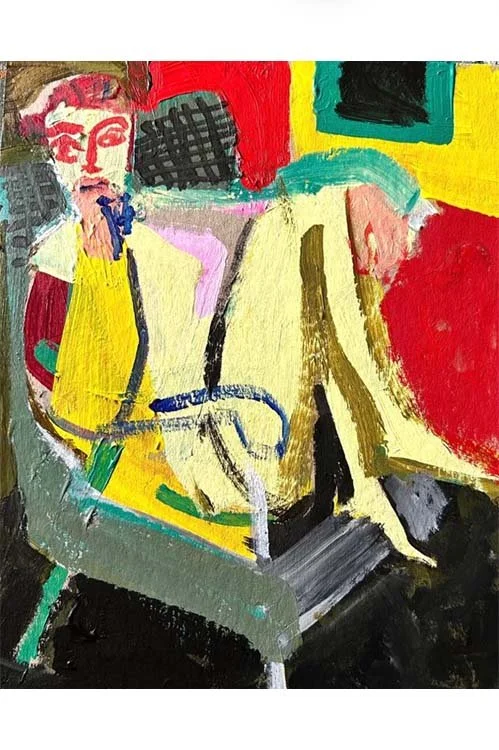 Image 3 of 4
 Image 4 of 4
The Story of a Painting (Online Workshop) Winter 2027 w/ Luke Hannam
January 13 to January 27 (Wednesdays), 10:00 AM to 1:00 PM, Eastern Time
**All sessions are live and will be recorded, students do not have to be present. All recordings will be available to students for 3 months after the final session, after 3 months the recording will be deleted.
Please check your email spam/junk folder for your Zoom invite. Our business hours are 10:00 AM through 5:00 PM. All course information and email correspondence will be sent during business hours. If students purchase a course, workshop, demo or recording outside business hours or during the weekend the course information or recording will be sent the following business day.
Workshop Description
In this workshop, we will explore the story of a painting: the evolution of an idea from curiosity to image. Paintings may begin with drawings, but before that they begin with a fascination—with a subject, a question, or another painter's vision. By looking closely at paintings, almost forensically, we can uncover how compositions are formed, how images become readable, and how stories are constructed to surprise, engage, and move us. This process of looking beneath the surface reveals painting as a continual transformation: a magical journey into the unknown. A painter is not searching for formulas, but for reasons to begin again, each painting becoming a new adventure in seeing and understanding.
Workshop Outline
Week One – Looking Closely
Intent
Every painting leaves evidence of its making. Before we can understand how to paint, we must first learn how to look. The opening week is devoted to observation, slowing down the act of looking so that students begin to recognise how paintings are constructed rather than simply what they depict.
Discussion
Students will take a forensic approach to the painting surface, examining how line, colour, shape, tone, edges and space work together to build an image. Through guided discussion, Luke will encourage students to move beyond description and consider the decisions that underpin the work.
Students will present selected paintings and participate in a diagnostic conversation designed to uncover the structure and logic behind each image. Throughout the session they will record observations and questions, gradually building a practical framework for making paintings.
Studio Practice
Students will produce a series of pencil drawings that translate form and colour back into line. By stripping away colour, they begin to understand how line alone can describe form, movement and structure.
Colour will then be explored intuitively rather than theoretically. Using chance methods—allowing any colour to occupy any place—students will discover how trial and error can unlock unexpected relationships and move them beyond dependence on traditional colour theory.
Reflection
By the end of the week students will have developed a more analytical way of looking at paintings. Rather than asking What is this a picture of? they will begin asking How has this painting been made? This shift in perception establishes the foundation for the remainder of the programme.
Week Two – Developing the Picture
Intent
A successful painting invites repeated viewing. It contains tension, surprise and ambiguity, revealing itself gradually over time. This week investigates how composition and pictorial space create those qualities.
Discussion
Traditional painting has largely been built upon tone—the relationship between light and dark within a colour. While tonal painting often feels logical and structured, colour operates more intuitively. Both, however, rely upon an understanding of pictorial space. The session explores the relationship between tone, value and hue, considering how each contributes to the construction of a painting. Students will also discuss why understanding convention is essential before it can be challenged. The painter must learn the rules in order to break them.
One of the central ideas of the week is that every compelling painting begins with a problem. Rather than searching for certainty, students will learn to embrace uncertainty as the starting point for discovery.
Studio Practice
Students will make a painted copy of Luke Hannam's The Girl in the Erol Chair, concentrating on the organisation of space rather than imitation. This structured exercise provides a clear framework for understanding how colour creates depth, rhythm and movement within a painting. Students should print at least three copies of the image before the session and upload their work to Padlet.
A second exercise introduces chance into colour selection. Students will arrange six colours, number them one to six and use a dice to determine colour choices. By temporarily surrendering control, they are encouraged to discover unexpected colour relationships and challenge habitual decision-making.
Throughout the practical work we will examine how subtle shifts in colour, composition and structure transform descriptive images into paintings that are mysterious, evocative and emotionally resonant.
Reflection
By the end of the week students will recognise that composition is not about arranging objects but about organising relationships within space. They will begin to trust experimentation and understand that uncertainty is often the catalyst for meaningful discoveries.
Week Three – Finding Your Language
Intent
Developing a personal visual language is inseparable from developing a discerning eye. As painters become more attentive to what genuinely interests them, they begin to make work that feels increasingly authentic.
Discussion
Every painter needs something to say. In painting, this often begins with the motif—a recurring shape, object, symbol or image that continually demands investigation. A motif becomes the vehicle through which painting evolves, allowing ideas to be revisited, challenged and transformed over time. Rather than searching for originality, students are encouraged to pursue genuine curiosity. Personal language grows through sustained enquiry rather than novelty.
Studio Practice
Using sketchbooks, drawings, photographs and previous work, students will identify a motif that repeatedly appears within their practice or one that continues to capture their imagination. The first task is simply to place the motif within the picture. This initial decision should not become an obstacle but an invitation to experiment. Through repeated adjustments of scale, position, cropping and surrounding space, students will discover how small changes dramatically alter the character of a painting. If students struggle to identify a motif, borrowing one is entirely acceptable. The purpose of the exercise is not to create a finished artwork but to understand the processes through which paintings develop.
Reflection
Students will leave the week with a clearer understanding that a personal visual language is not something that is invented overnight. It emerges through repetition, observation, experimentation and the gradual discovery of what continues to matter to them as painters. They will begin to recognise that while every painting may start with a motif, it is the organisation of space, colour and form that ultimately gives the work its voice.
Workshop Materials List
4b, 6b Pencil, Graphite Stick
Scissors
Photographs
Secondary Information
Scrap paper
Gouache Paint
Brushes
Grey Card
January 13 to January 27 (Wednesdays), 10:00 AM to 1:00 PM, Eastern Time
**All sessions are live and will be recorded, students do not have to be present. All recordings will be available to students for 3 months after the final session, after 3 months the recording will be deleted.
Please check your email spam/junk folder for your Zoom invite. Our business hours are 10:00 AM through 5:00 PM. All course information and email correspondence will be sent during business hours. If students purchase a course, workshop, demo or recording outside business hours or during the weekend the course information or recording will be sent the following business day.
Workshop Description
In this workshop, we will explore the story of a painting: the evolution of an idea from curiosity to image. Paintings may begin with drawings, but before that they begin with a fascination—with a subject, a question, or another painter's vision. By looking closely at paintings, almost forensically, we can uncover how compositions are formed, how images become readable, and how stories are constructed to surprise, engage, and move us. This process of looking beneath the surface reveals painting as a continual transformation: a magical journey into the unknown. A painter is not searching for formulas, but for reasons to begin again, each painting becoming a new adventure in seeing and understanding.
Workshop Outline
Week One – Looking Closely
Intent
Every painting leaves evidence of its making. Before we can understand how to paint, we must first learn how to look. The opening week is devoted to observation, slowing down the act of looking so that students begin to recognise how paintings are constructed rather than simply what they depict.
Discussion
Students will take a forensic approach to the painting surface, examining how line, colour, shape, tone, edges and space work together to build an image. Through guided discussion, Luke will encourage students to move beyond description and consider the decisions that underpin the work.
Students will present selected paintings and participate in a diagnostic conversation designed to uncover the structure and logic behind each image. Throughout the session they will record observations and questions, gradually building a practical framework for making paintings.
Studio Practice
Students will produce a series of pencil drawings that translate form and colour back into line. By stripping away colour, they begin to understand how line alone can describe form, movement and structure.
Colour will then be explored intuitively rather than theoretically. Using chance methods—allowing any colour to occupy any place—students will discover how trial and error can unlock unexpected relationships and move them beyond dependence on traditional colour theory.
Reflection
By the end of the week students will have developed a more analytical way of looking at paintings. Rather than asking What is this a picture of? they will begin asking How has this painting been made? This shift in perception establishes the foundation for the remainder of the programme.
Week Two – Developing the Picture
Intent
A successful painting invites repeated viewing. It contains tension, surprise and ambiguity, revealing itself gradually over time. This week investigates how composition and pictorial space create those qualities.
Discussion
Traditional painting has largely been built upon tone—the relationship between light and dark within a colour. While tonal painting often feels logical and structured, colour operates more intuitively. Both, however, rely upon an understanding of pictorial space. The session explores the relationship between tone, value and hue, considering how each contributes to the construction of a painting. Students will also discuss why understanding convention is essential before it can be challenged. The painter must learn the rules in order to break them.
One of the central ideas of the week is that every compelling painting begins with a problem. Rather than searching for certainty, students will learn to embrace uncertainty as the starting point for discovery.
Studio Practice
Students will make a painted copy of Luke Hannam's The Girl in the Erol Chair, concentrating on the organisation of space rather than imitation. This structured exercise provides a clear framework for understanding how colour creates depth, rhythm and movement within a painting. Students should print at least three copies of the image before the session and upload their work to Padlet.
A second exercise introduces chance into colour selection. Students will arrange six colours, number them one to six and use a dice to determine colour choices. By temporarily surrendering control, they are encouraged to discover unexpected colour relationships and challenge habitual decision-making.
Throughout the practical work we will examine how subtle shifts in colour, composition and structure transform descriptive images into paintings that are mysterious, evocative and emotionally resonant.
Reflection
By the end of the week students will recognise that composition is not about arranging objects but about organising relationships within space. They will begin to trust experimentation and understand that uncertainty is often the catalyst for meaningful discoveries.
Week Three – Finding Your Language
Intent
Developing a personal visual language is inseparable from developing a discerning eye. As painters become more attentive to what genuinely interests them, they begin to make work that feels increasingly authentic.
Discussion
Every painter needs something to say. In painting, this often begins with the motif—a recurring shape, object, symbol or image that continually demands investigation. A motif becomes the vehicle through which painting evolves, allowing ideas to be revisited, challenged and transformed over time. Rather than searching for originality, students are encouraged to pursue genuine curiosity. Personal language grows through sustained enquiry rather than novelty.
Studio Practice
Using sketchbooks, drawings, photographs and previous work, students will identify a motif that repeatedly appears within their practice or one that continues to capture their imagination. The first task is simply to place the motif within the picture. This initial decision should not become an obstacle but an invitation to experiment. Through repeated adjustments of scale, position, cropping and surrounding space, students will discover how small changes dramatically alter the character of a painting. If students struggle to identify a motif, borrowing one is entirely acceptable. The purpose of the exercise is not to create a finished artwork but to understand the processes through which paintings develop.
Reflection
Students will leave the week with a clearer understanding that a personal visual language is not something that is invented overnight. It emerges through repetition, observation, experimentation and the gradual discovery of what continues to matter to them as painters. They will begin to recognise that while every painting may start with a motif, it is the organisation of space, colour and form that ultimately gives the work its voice.
Workshop Materials List
4b, 6b Pencil, Graphite Stick
Scissors
Photographs
Secondary Information
Scrap paper
Gouache Paint
Brushes
Grey Card