
 Image 1 of 1
Water and Pigment (Online Workshop) Winter 2027 w/ Deena Ball
January 26 to February 9 (Tuesdays), 1:00 PM to 4:00 PM, Eastern Time
**All sessions are live and will be recorded, students do not have to be present. All recordings will be available to students for 3 months after the final session, after 3 months the recording will be deleted.
Please check your email spam/junk folder for your Zoom invite. Our business hours are 10:00 AM through 5:00 PM. All course information and email correspondence will be sent during business hours. If students purchase a course, workshop, demo or recording outside business hours or during the weekend the course information or recording will be sent the following business day.
Workshop Description
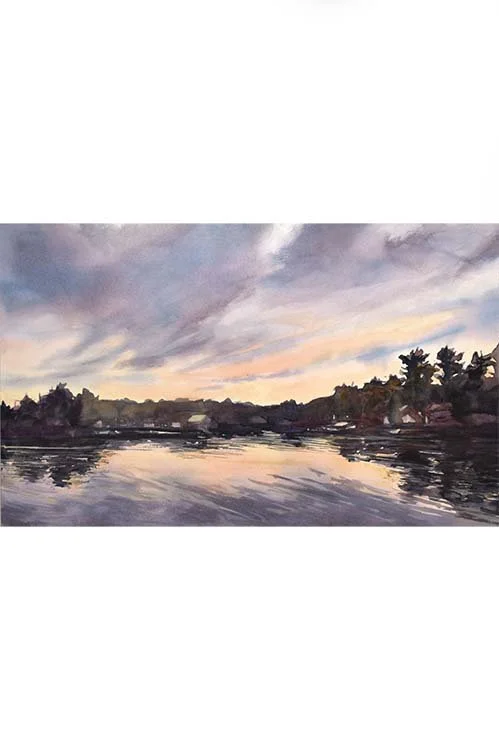
Water and Pigment is a workshop for watercolorists focused on controlling the water-to-pigment ratio and using each paint’s characteristics to your advantage. In the first session, students will be introduced to exercises that help them understand the properties of their pigments. In the second week, students will learn to make the most of each pigment’s unique qualities using both their usual brushes and alternative painting tools. In the final session, students will apply their new knowledge of water-to-pigment ratios to create a landscape painting.
Workshop Outline
Week 1: Understanding Your Pigments
Goal: Build a working knowledge of how each pigment behaves so you can predict results when you change the water-to-pigment ratio.
We will:
Make simple pigment “profiles” (strength, transparency, staining, granulation, liftability).
Create a series of controlled washes that move from tea to milk to cream consistency.
Practice wet-into-wet vs. wet-on-dry to see how the same pigment responds in each approach.
Keep notes so you can recreate your favorite effects later.
Takeaway: A personal pigment reference sheet that you can use as a guide in future paintings.
Week 2: Using Pigment Properties on Purpose
Goal: Learn how to make pigments work for you by understanding interaction, layering, and application methods.
We will:
Explore how pigments interact in mixes and glazes, including when and why mixtures get dull or stay luminous.
Compare granulating and super-granulating pigments with smooth pigments to see how texture develops.
Practice using opaques (for example, Holbein Lavender or similar) to control edges, atmosphere, and highlights.
Try nontraditional tools and application methods to enhance texture and marks.
Takeaway: A set of interaction studies and strategies for choosing pigments based on the effect you want.
Week 3: Create a Landscape Painting (Putting It All Together)
Goal: Apply the week one and two studies to create a finished landscape that showcases your paints’ characteristics.
We will:
Choose a reference from the provided photos and plan a simplified composition.
Decide where granulation, texture, and smooth washes will best support the mood.
Build the painting in intentional stages, controlling water and pigment to protect light and create depth.
Add final accents and highlights with purpose, keeping the painting fresh and cohesive.
Takeaway: A completed painting and a repeatable process for planning and executing future landscapes.
Workshop Materials
Rubber Mini Squeegee
https://www.amazon.com/gp/product/B0DMNX3N5H/ref=ewc_pr_img_1?smid=ADDYS8VJWV9TQ&th=1
needle tip glue bottle or a syringe
small bottle or dish to mix up a lot of paint
palette - or porcelain dishes
Waterford Saunders or Arches 300 lb cold press paper - one sheet should be enough
Water Resistant backing board and tape - I use gatorboard and white artist tape
Brushes should be large, hold a lot of water and have a good point.
Large round brush - Jacksons Art quill #6 recommended
Large Flat Brush - 2 inch or more - mostly used for putting a lot of water on the paper
Liner or other thin brush
spray bottle - I like an olive oil spray bottle because it has a more consistent spray.
Paints - tube watercolors
Base colors are Winsor Newton- Smalt Blue, French Ultramarine, Cerulean Blue, Permanent Rose, Transparent Yellow, Deep Gold, Indigo
Opaque Color - my favorite is Holblein Lavender -or another light value opaque color ( Shell pink or Jaune Brilliant or even titanium white)
Granulating Colors
Either Holblein Mineral violet or Daniel Smith Moonglow
Daniel Smith Transparent Red Oxide
At least one of tube of Schmincke Horadam Aquarell Super Granulating Watercolors suggested color choice-Tundra Violet, Haze Blue, Shire Blue
January 26 to February 9 (Tuesdays), 1:00 PM to 4:00 PM, Eastern Time
**All sessions are live and will be recorded, students do not have to be present. All recordings will be available to students for 3 months after the final session, after 3 months the recording will be deleted.
Please check your email spam/junk folder for your Zoom invite. Our business hours are 10:00 AM through 5:00 PM. All course information and email correspondence will be sent during business hours. If students purchase a course, workshop, demo or recording outside business hours or during the weekend the course information or recording will be sent the following business day.
Workshop Description
Water and Pigment is a workshop for watercolorists focused on controlling the water-to-pigment ratio and using each paint’s characteristics to your advantage. In the first session, students will be introduced to exercises that help them understand the properties of their pigments. In the second week, students will learn to make the most of each pigment’s unique qualities using both their usual brushes and alternative painting tools. In the final session, students will apply their new knowledge of water-to-pigment ratios to create a landscape painting.
Workshop Outline
Week 1: Understanding Your Pigments
Goal: Build a working knowledge of how each pigment behaves so you can predict results when you change the water-to-pigment ratio.
We will:
Make simple pigment “profiles” (strength, transparency, staining, granulation, liftability).
Create a series of controlled washes that move from tea to milk to cream consistency.
Practice wet-into-wet vs. wet-on-dry to see how the same pigment responds in each approach.
Keep notes so you can recreate your favorite effects later.
Takeaway: A personal pigment reference sheet that you can use as a guide in future paintings.
Week 2: Using Pigment Properties on Purpose
Goal: Learn how to make pigments work for you by understanding interaction, layering, and application methods.
We will:
Explore how pigments interact in mixes and glazes, including when and why mixtures get dull or stay luminous.
Compare granulating and super-granulating pigments with smooth pigments to see how texture develops.
Practice using opaques (for example, Holbein Lavender or similar) to control edges, atmosphere, and highlights.
Try nontraditional tools and application methods to enhance texture and marks.
Takeaway: A set of interaction studies and strategies for choosing pigments based on the effect you want.
Week 3: Create a Landscape Painting (Putting It All Together)
Goal: Apply the week one and two studies to create a finished landscape that showcases your paints’ characteristics.
We will:
Choose a reference from the provided photos and plan a simplified composition.
Decide where granulation, texture, and smooth washes will best support the mood.
Build the painting in intentional stages, controlling water and pigment to protect light and create depth.
Add final accents and highlights with purpose, keeping the painting fresh and cohesive.
Takeaway: A completed painting and a repeatable process for planning and executing future landscapes.
Workshop Materials
Rubber Mini Squeegee
https://www.amazon.com/gp/product/B0DMNX3N5H/ref=ewc_pr_img_1?smid=ADDYS8VJWV9TQ&th=1
needle tip glue bottle or a syringe
small bottle or dish to mix up a lot of paint
palette - or porcelain dishes
Waterford Saunders or Arches 300 lb cold press paper - one sheet should be enough
Water Resistant backing board and tape - I use gatorboard and white artist tape
Brushes should be large, hold a lot of water and have a good point.
Large round brush - Jacksons Art quill #6 recommended
Large Flat Brush - 2 inch or more - mostly used for putting a lot of water on the paper
Liner or other thin brush
spray bottle - I like an olive oil spray bottle because it has a more consistent spray.
Paints - tube watercolors
Base colors are Winsor Newton- Smalt Blue, French Ultramarine, Cerulean Blue, Permanent Rose, Transparent Yellow, Deep Gold, Indigo
Opaque Color - my favorite is Holblein Lavender -or another light value opaque color ( Shell pink or Jaune Brilliant or even titanium white)
Granulating Colors
Either Holblein Mineral violet or Daniel Smith Moonglow
Daniel Smith Transparent Red Oxide
At least one of tube of Schmincke Horadam Aquarell Super Granulating Watercolors suggested color choice-Tundra Violet, Haze Blue, Shire Blue